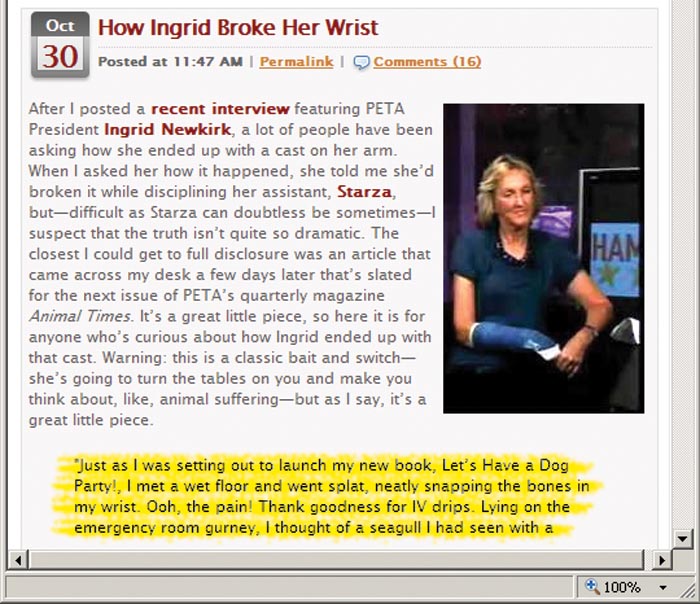
Two weeks ago, People for the Ethical Treatment of Animals (PETA) president Ingrid Newkirk was spotted giving an interview at a film festival in the Hamptons. With a bright blue cast on her right forearm. On PETA’s blog, she later explained how she broke her wrist:
Just as I was setting out to launch my new book, Let’s Have a Dog Party!, I met a wet floor and went splat, neatly snapping the bones in my wrist. Ooh, the pain! Thank goodness for IV drips. Lying on the emergency room gurney …
Where to begin?
It’s possible that Newkirk’s wrists were unusually fragile because her vegan diet (with no dairy foods) rendered her calcium-deficient. Setting that aside, we agree that IV (intravenous) drips of painkillers are a good thing. And we don’t know which drug she was on, assuming it didn’t come from PETA’s “Let’s Have a Dog Party!” tackle box. But the most commonly prescribed IV painkillers, fentanyl and meperidine (Demerol), have both been extensively tested on animals.
In fact, the IV drip mechanism itself was tested on several species of animals during the 1930s, during the development of techniques for surgical anaesthesia. We’re betting Newkirk’s ER visit was chock full of such “ethical” compromises. For more information about how animals are responsibly used to test the safety and effectiveness of commonplace medical miracles, click here, here, and here.
Ingrid Newkirk, you may recall, once told a reporter that “even if animal research resulted in a cure for AIDS, we’d be against it.” Fair enough. But there’s a big difference between talking the talk and walking the walk.
Add Newkirk to the list of hypocritical animal-rights leaders who let their principles slide when push comes to shove. Others include insulin-diabetic PETA Vice President Mary Beth Sweetland, hepatitis-C carrying PETA spokesbimbo Pamela Anderson, and breast-cancer survivor Simon Chaitowitz of the animal-rights Physicians Committee for Responsible Medicine. Like Newkirk, these three women owe their lives to medical research that required the use of animals.
It would be nice if they were in the habit of thanking scientists instead of attacking them.